China Environment FY2014: Significant Deterioration in Receivables Collectability And No Provision for Impairment

By Roy KIM Jia Liang and KB Kee

China Environment (SES: 50U, Bloomberg: CENV SP) FY2014:

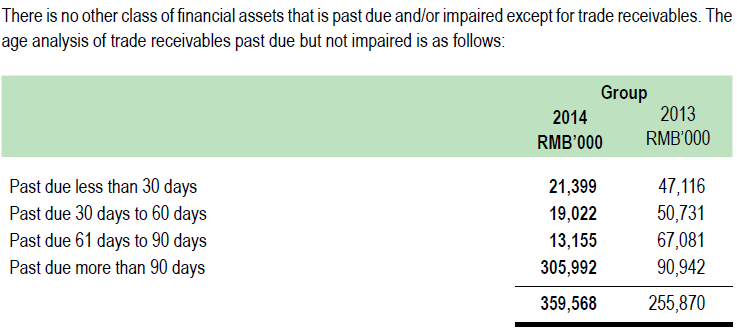
  • Receivables past due more than 90 days exploded from RMB90m in FY13 (17% of sales, 12% of current assets) to RMB306m (52.4% of sales, 34% of current assets) in FY14, with no provision for impairment. Cash and Cash Equivalents down from RMB90.3m in FY13 to RMB8.8m in FY14.
  • Notice how the “trade receivables not past due” (“deposits with bank”?) amounting to RMB297m eerily approximates the sum of Amount due to related parties RMB86.6m, Short-term borrowings RMB173.4m and Bank balances pledged RMB39.5m. Are these circular money-go-round transactions in money pledged to give loan guarantees and loans to related-parties?
  • Overall: Further doubts are cast on the propriety and reliability of receivables and revenue figures with the potential risk of undisclosed related-party transactions severely misrepresenting the financial status of the company.
  • Chronology of events:
  1. Feb 10, 2015: Part 1 of article series on China Environment highlighting accounting and governance issues. Part 2 on Feb 17, Part 3 on Feb 23.
  2. Feb 16, 2015: CFO CT Chiar replied using the moniker “Sadme” and a personal email (zzh721@yahoo.com).
  3. Feb 27, 2015: Unaudited FY14 financial results announcement with 4Q14 sales and profit witnessing a sudden plunge, corresponding with a sharp decrease in cash and a sudden increase in “Other Receivables (Unsecured, Interest-Free Advances to Unidentified Mysterious Subcontractor With No Provision for Impairment to Mitigate Default or Non-Repayment Risk)”.
  4. Mar 9, 2015: Open Letter to SGX/MAS: Reply to CFO of SGX-Listed China Environment (CENV SP) on report “Potential Accounting Tunneling Fraud at China Environment?” – Address the accounting and governance concerns in an SGX/MAS announcement.
  5. Apr 2, 2015: Auditor Emphasis of Matter and the partial repayment (disgorging?) of cash taken out from the listco. Read: (1) China Environment: Auditor Emphasis of Matter raises more questions on potential accounting tunneling risk, (2) Does Auditor Explanatory Language in Unqualified Audit Reports Indicate Increased Financial Misstatement Risk? “Emphasis of matter” language predicts restatements,
  6. Apr 13, 2015: Receivables past due more than 90 days exploded.

CEL_Aging Receivables Continue reading

Winsway (1733 HK) Missed Bond Payment Heightens Chinese Default Risk

http://www.bloomberg.com/news/articles/2015-04-09/winsway-misses-dollar-bond-payment-as-asia-coal-distress-deepens

Winsway Missed Bond Payment Heightens Chinese Default Risk

byDavid Yong

April 9, 2015

Investors in coal-related companies face heightened default risks after one that relies on markets in China and Mongolia became the latest Chinese corporate to miss an interest obligation.

Winsway Enterprises Holdings Ltd., an importer of coal for steelmakers, didn’t make a $13.15 million semi-annual coupon payment due Wednesday on $309.3 million of notes maturing in April 2016, according to a stock exchange filing. It plans to use a 30-day grace period to discuss restructuring the debt after hiring Akin Gump Strauss Hauer & Feld LLP as a legal adviser to an expected group of bondholders. Continue reading

Ozner (2014 HK): Glaucus Research’s Rebuttals

(2014) Ozner Water International :
Glaucus Research announced another report commenting on Ozner Water’s announcement as “not entirely accurate,” “inconsistent,” and “not inclusive of all changing scenarios”. The short-seller kept their suggestion of Strong Sell. In relation to the allegation of material exaggeration of sales, production and profit, Ozner Water explained days ago that the purported discrepancy is primarily attributable to the timing difference in revenue recognition for accounting and tax reporting purposes.

A Muddy Waters-Carson Block short has been frozen by the Chinese government, and the stock hasn’t traded at all today

http://www.businessinsider.sg/500com-halted-after-agreement-2015-4/#.VSOO3PmUeCk

A Carson Block short has been frozen by the Chinese government, and the stock hasn’t traded at all today

JULIA LA ROCHE FINANCE  APR. 7, 2015, 3:41 AM

Carson Block mentioned 500.com as a short back in September.

Shares of Chinese sports lottery site 500.com (WBAI) have been halted since Monday morning with news pending.

On Friday, 500.com said it reached an agreement with the Chinese government that essentially suspended the company’s business. “The Company plans to voluntarily and temporarily suspend all of its online lottery sales services starting from April 4, 2015. During this temporary suspension period the Company expects that it will not generate any revenue,” the statement said (See full statement below). 500.com is also a target of influential short-seller Carson Block. Shares have fallen 64% since he publicly mentioned the stock at a private conference in New York City back in September. Continue reading

China Environment: Auditor Emphasis of Matter raises more questions on potential accounting tunneling risk

China Environment: Auditor Emphasis of Matter in RMB127m unsecured and interest-free advances to sub-contractor raises more questions on potential accounting tunneling risk

Related post: (1) Open Letter to SGX/MAS: Reply to CFO of SGX-Listed China Environment (CENV SP) on report “Potential Accounting Tunneling Fraud at China Environment?” – Address the accounting and governance concerns in an SGX/MAS announcement, (2) Does Auditor Explanatory Language in Unqualified Audit Reports Indicate Increased Financial Misstatement Risk? “Emphasis of matter” language predicts restatements

We note the SGX announcement made by China Environment  (SES: 50U, Bloomberg: CENV SP) on 2 April 2015 with the auditor Baker Tilly making an “Emphasis of Matter” with regards to Footnote 18 in the RMB127m in unsecured and interest-free “Advances/Loan to a sub-contractor”. This is essentially short-term money that can be shifted around and “repaid” by the close of financial period and “taken” again without the guarantee of repayment or recoverability and there is no collateral at all to offset this non-repayment risk imposed on the minority shareholders. Importantly, this emphasis of matter begs several important additional questions that requires proper disclosure for accountability to the minority shareholders given the significance of the sum:

(1) Who is this sub-contractor? Is this a related-party? If this is an “independent” party, it will be necessary for the auditor to ascertain and verify this material information, including the financial track record of this sub-contractor in the event of default. There should be – must be – proper bad debt provisions if these information are not disclosed and ascertained. Also, if the sub-contractor is incorporated in the offshore haven centers, it will be hard to recover back the amount and the ultimate identity can be easily hidden to escape any asset tracing in the event of non-repayment. What is to stop the non-repayment?? This is an obvious red flag in accounting fraud.

(2) Why is this huge amount “lent out” in the first place? And interest-free and unsecured! What is the nature of the relationship to warrant such terms? Without this loans amount, will “revenue” wax and wane with such short-term financing schemes? So with the partial repayment of RMB82.2m after the 27 Feb 2015 announcement, investors and minority shareholders must be even more watchful and suspicious should 1Q 2015 revenue show a corresponding increase in revenue by around RMB82m.

(3) Why does the 4Q14 revenue plunge by RMB122.5m correspond to this “advances to sub-contractor” amount of RMB127m? This is particularly worrying and a cause for accounting tunneling risk with these short-term financing routed to related party vehicles posing as fictitious customers to engage in artificial sales in prior periods – and the abrupt decline in the revenue that correspond to the non-repayment risk of this short-term loan highlights that this scheme may be unwound easily, leading to the missing cash and cash equivalents. This casts huge doubt on the revenue recognition policy and revenue reliability of the listco. Like most capital equipment companies, this should be treated as debt on the liability side since it is the same as the machinery companies incurring a debt and then selling the machines to customers on credit. The cashflow from operations that come from this purported vendor financing activity should be re-categorised as cashflow from financing, which would turn most of these companies to be running negative operating cashflow positions. In other words, if the RMB660m in trade and bill receivables is funded by this “vendor financing”, there should be a corresponding RMB127m in debt liabilities recorded in the balance sheet, or the NET trade and bill receivables to decreased by RMB127m.

In addition, we think that the statement “In our opinion, the accounting and other records required by the Act to be kept by the Company and by those subsidiaries incorporated in Singapore of which we are the auditors, have been properly kept in accordance with the provisions of the Act” is misleading, given that this evades the non-Singapore-incorporated and PRC-incorporated key subsidiaries Fujian Duoyuan and Anhui Dongyuan which formed the substantial bulk of the audit risk.

We urge the independent auditor Baker Tilly to assist the minority shareholders and the investing public with more transparent and clear disclosures. We note that Baker Tilly’s Hong Kong practice has been banned by the US Securities and Exchange Commission from taking on any new US-listed clients until its audit policies and procedures have been reviewed by an independent consultant – due to its audit failure for failure in disclosing the magnitude and impact of the related-party transactions in another Chinese company (China North East Petroleum Holdings) which was charged in accounting fraud. We urge the independent auditor Baker Tilly’s Singapore practice to uphold its critical gatekeeper role and help restore trust in the capital markets in Singapore.

Thank you.

Warm regards,
KB Kee Continue reading

Toshiba Drops Most Since 2012 After Accounting Probe; panel formed to examine the “reasonableness of estimates” when using the percentage-of-completion accounting method for some projects

http://www.bloomberg.com/news/articles/2015-04-06/toshiba-drops-most-since-2012-after-accounting-probe

Toshiba Drops Most Since 2012 After Accounting Probe

byTakashi AmanoPavel Alpeyev

April 6, 2015

Toshiba Corp. fell the most in more than two years after the company said it would appoint a committee to investigate possible problems with its accounting. The maker of nuclear reactors, chips, appliances and electronics dropped as much as 9 percent, the most since July 2012. The shares traded 5.7 percent lower at 483.2 yen as of 10:33 a.m. in Tokyo.

Toshiba said Friday after the market closed that it would form a panel to examine the “reasonableness of estimates” when using the percentage-of-completion accounting method for some projects. The effect on earnings hasn’t been determined, according to the Tokyo-based company’s statement. Continue reading

Qinfa (866 HK): Belated Audit Qualification on Accounting Tunneling Fraud (Auditor KPMG)

Related posts: (1) China Taifeng Beddings (873 HK): Typical Misleading “Value Stock” with “Low” PE and P/B Ratios – Delay in Publication of 2014 Annual Results Due to Audit Failure in Ascertaining Fair Value of Financial Guarantee Contracts on Borrowings of Subsidiary and Impairment of the Recoverable Amounts of the Group’s Assets (2) Open Letter to SGX/MAS: Reply to CFO of SGX-Listed China Environment (CENV SP) on report “Potential Accounting Tunneling Fraud at China Environment?” – Address the accounting and governance concerns in an SGX/MAS announcement

Loss attributable to equity shareholders of the Company for the year increased to RMB1,183.4 million in 2014, as compared with RMB247.8 million in 2013. The loss included the one-off and predominately non-cash loss arising from the loss on disposal of a subsidiary, reduction of deferred tax assets and impairment losses on interest in an associate, property, plant and equipment and prepayments and other receivables in the total amount of RMB372.7 million.

EXTRACT OF INDEPENDENT AUDITOR’S REPORT

The independent auditor of the Company will issue a disclaimer of opinion on the consolidated financial statements of the Group. The below section set out an extract of independent auditor’s report regarding the consolidated financial statements of the Group for the year ended 31 December 2014:

Basis for disclaimer of opinion

Limitation of scope in respect of certain consolidated statement of financial position items in prior year

The consolidated financial statements of the Group for the year ended 31 December 2013 were audited by another auditor whose report dated 31 March 2014 expressed a disclaimer of opinion in respect of the matters as described below. The predecessor auditor was unable to obtain sufficient audit evidence to ascertain the following matters: (a) the actual originating source or the payees and the nature of the bank receipts of RMB471,567,000 into the Group’s bank account during the year ended 31 December 2013 in relation to settlement of trade receivable balances due from several customers of Shanxi HunYuan Ruifeng Coal Co., Ltd. (“Ruifeng”) and the accuracy and recoverability of the outstanding trade receivable balances of RMB264,029,000 due from these customers as at 31 December 2013; (b) validity of the leasing income of RMB137,500,000 from certain tenants of Ruifeng for the year ended 31 December 2013 and the related outstanding trade receivable balance of RMB68,750,000 as at 31 December 2013; (c) the actual originating source or the payees or the nature of the bank receipts of RMB132,270,000 and RMB463,819,000 during the year ended 31 December 2013 and the period from 1 January 2014 to 31 March 2014 respectively in relation to settlement of trade receivable balances due from several customers of the Group and the accuracy and recoverability of the outstanding trade receivable balances of RMB752,933,000 due from these customers as at 31 December 2013 (the “Trade Receivables”); (d) the recoverability of an outstanding balance of RMB622,327,000 due from non-controlling shareholders (the “Amount Due from NCI”) as at 31 December 2013; and (e) the nature and recoverability of prepayments of RMB161,460,000 as at 31 December 2013 which was purported to be prepayments to certain suppliers for purchase of goods (the “Prepayments”).

In relation to above matters (a) and (b), as described in Note 32 to the consolidated financial statements, the Company disposed of its entire equity interest in Ruifeng on 29 December 2014 and recognised a loss of RMB162,585,000 (the “Loss of Ruifeng Disposal”). In relation to above matter (c), the Trade Receivable were settled during the year ended 31 December 2014. In relation to above matter (d), during the year and subsequent to the year ended 31 December 2014, non-controlling shareholders have made settlements amounting to RMB285,226,000. In relation to above matter (e), the Prepayments of RMB135,171,000 were utilised during the year ended 31 December 2014. A provision for impairment of the remaining Prepayments of RMB26,289,000 was made during the year (the “Loss of Prepayments”). Because of the unavailability of reliable financial information, we were unable to obtain sufficient appropriate audit evidence and were unable to carry out alternative audit procedures to satisfy ourselves about the balances as of 31 December 2013 mentioned in matter (a) to (e) above. Any adjustments to these balances as of 31 December 2013 would have a consequential effect on the Loss of Ruifeng Disposal, Loss of Prepayments, if any, for the years ended 31 December 2014, and the related elements making up the consolidated statement of changes in equity, the consolidated statement of cash flows and the related disclosures in the financial statements.

Disclaimer of opinion

Because of the significance of the matters described in the basis for disclaimer of opinion paragraphs, we have not been able to obtain sufficient appropriate audit evidence to provide a basis for an audit opinion. Accordingly, we do not express an opinion as to whether the consolidated financial statements give a true and fair view of the state of affairs of the Company and of the Group as at 31 December 2014 and of the Group’s loss and cash flows for the year then ended in accordance with International Financial Reporting Standards and as to whether the consolidated financial statements have been properly prepared in accordance with the disclosure requirements of the Hong Kong Companies Ordinance.

Emphasis of matter

Without qualifying our opinion, we draw attention to Note 1(c) to the consolidated financial statements which indicates that the Group incurred a consolidated net loss of RMB1,292,313,000 during the year ended 31 December 2014 and, as of that date, the Group had net current liabilities of RMB5,278,281,000. These conditions, along with other matters as set forth in Note 1(c) to the consolidated financial statements, indicate the existence of a material uncertainty that may cast significant doubt about the Group’s ability to continue as a going concern.

Other matter

The consolidated financial statements of the Group for the year ended 31 December 2013 were audited by another auditor who expressed a disclaimer of opinion as described above, on those statements on 31 March 2014.

China Ting (3398 HK) – Net Loss due to Entrusted loans turned sour + Reclassification of equity investment in property asset from investment in associate to available-for-sale financial asset at fair value

26 March 15

(3398) China Ting: China Ting Group Holdings confirmed that its loss before the tax for the year ended 31 December 2014 will increase from previously  estimated HK$193 m to HK$246.9 m due to the following additional factors: (1) An impairment amount of HK$83.5 m is charged on the re-classification of its investment in Zhejiang Haoran Property Company; (2) A pro vision for bad and doubtful debt for HK$17.7 m regarding two entrusted loans of RMB160 m; (3) Increase in the estimated amount of operating profit for the last two months of 2014

20 January 15

CBRC issued draft rules restricting entrusted loans in a bid to curb excessive margin finance. The draft rules said banks shall not bear credit risks if the loan defaults, and lenders shall not issue entrusted loans if the fund is raised for specific uses by the authorities or raised from bank lending. Banks shall not issue entrusted loans using funds raised through debts, raised from other companies or individuals, or other sources that cannot be identified. Entrusted loans is a form of inter-company loan where bank intermediates one company’s lending to another company’s borrowing and collect a fee in the process. Entrusted loans have been used as a margin trading channel that may bring risks to banks as in the past when there was default in lending, it was usually the banks that bore the risks, said market insiders. The draft rules are open to public comment until 16 Feb for sugg estions on amendments