[Flashback] Tianhe hits back at fraud claims with 55-page rebuttal

http://www.ft.com/intl/cms/s/0/a39fa7e6-4f67-11e4-9c88-00144feab7de.html#axzz3QfbQsc7sx

Posted by LIM Hui Jie, Year 4 undergrad at the School of Economics, Singapore Management University

Tianhe Chemicals shares tumbled 26 per cent after a five­week trading suspension following allegations of accounting fraud. The Chinese chemicals group released a 55­page rebuttal of fraud claims late on Wednesday, arguing that Anonymous Analytics, a group claiming links to Anonymous, the shadowy hacker collective, “used fabricated financial statements to mislead investors”. The short­seller attack from Anonymous caused Tianhe, which had only listed in June with a market capitalisation of about $8bn, to suspend its shares on September 2.

[Flashback] WiFi provider Gowex goes bankrupt and admits falsifying accounts

http://www.ft.com/intl/cms/s/0/851d118c-0516-11e4-b098-00144feab7de.html#axzz3QfbQsc7s

Posted by LIM Hui Jie, Year 4 undergrad at the School of Economics, Singapore Management University

One of the brightest stars of the Madrid stock market imploded on Sunday, after WiFi provider Let’s Gowex was forced to declare bankruptcy and admit that its chief executive and founder had falsified the company’s accounts for at least the past four years.

Continue reading

[Flashback] CEO suspended at Saudi telecoms group hit by accounting scandal

http://www.ft.com/intl/cms/s/0/c186cf94-69cc-11e4-8f4f-00144feabdc0.html#axzz3QfbQsc7s

Posted by LIM Hui Jie, Year 4 undergrad at the School of Economics, Singapore Management University

An accounting scandal at one of Saudi Arabia’s largest telecommunications companies is posing the first major test of the Gulf monarchy’s regulators, as Riyadh moves to open up the Arab world’s largest stock market to foreign investors next year.

Continue reading

The Morning Risk Report: Chinese Regulators Choose Their Own Time to Strike

http://blogs.wsj.com/riskandcompliance/2015/01/30/the-morning-risk-report-chinese-regulators-choose-their-own-time-to-strike/

Posted by CHUA Sing Nee, Year 3 undergrad at the School of Social Science, Singapore Management University

China’s government accused Alibaba Group Holding Ltd.BABA -0.82% of allowing counterfeiting across its giant online marketplace in a paper made public Wednesday.  But allegations of counterfeiting are nothing new for Alibaba. In Alibaba’s own IPO prospectus, released last May, the e-commerce giant acknowledged the “widespread” perception that counterfeit goods on its platform are “commonplace.” So why is the Chinese government raising the issue now? Continue reading

Shares of Chaoda Modern Agriculture (0682) slumped 45.45 percent to HK$0.60 after it resumed trading after being suspended for more than three years for accounting fraud

http://www.thestandard.com.hk/news_detail.asp?we_cat=2&art_id=153909&sid=43813822&con_type=1&d_str=20150203&fc=2

Bleak restart for Chaoda Modern shares
Tuesday, February 03, 2015
Shares of Chaoda Modern Agriculture (0682) slumped 45.45 percent to HK$0.60 yesterday after it resumed trading after being suspended for more than three years.The stock had a turnover of HK$241.39 million. The Fujian-based food maker said it lost HK$1.94 billion in the year ended June 30 of 2014, much less than the HK$3.22 billion lost in 2013. Annual revenue fell 36.05 percent to HK$1.46 billion. It expects to record 20 to 30 percent of year-on-year loss for the six months ended December 31 of 2014, due to low demand for the products and the writing off of prepaid premium for certain land leases. On September 26 of 2011, the financial secretary said the government was investigating its chairman Kwok Ho, chief financial officer Andy Chan Chi-po and another individual on market misconduct, including insider trading. At the same time, research firm Anonymous Analytics published a 38-page report alleging Chaoda’s management transferred US$400 million (HK$3.12 billion) capital from the firm through exaggerating the capital expenses or forging transaction records. The firm did not fight back against the accusation until July 2013, saying that the allegations were untrue. JENNIFER LI

Would You Still Buy Alibaba If It Were Two-Thirds Smaller? If 80% of Taobao’s products are fake, illegal, or substandard, look for that site’s gross merchandise volume-the metric Alibaba uses-to shrink by a large percentage

http://www.forbes.com/sites/gordonchang/2015/02/01/would-you-still-buy-alibaba-if-it-were-two-thirds-smaller/print/

Gordon G. ChangContributor

WORLD AFFAIRS 2/01/2015 @ 3:22PM 52,877 views

Would You Still Buy Alibaba If It Were Two-Thirds Smaller?

On Friday, the State Administration for Industry & Commerce, through a spokesman, tried to minimize a damning report it had issued on Wednesday on Taobao Marketplace, one of the main sites of Hangzhou-based Alibaba Group. The Wednesday report created legal exposure for the Chinese Internet giant and, more significantly, highlights the ultimate unsustainability of its business model. Continue reading

Possible Class Action Suit Against Alibaba For Disclosure Failures in issuing materially false and misleading statements regarding the soundness of company’s business operations, the strength of its financial prospects and concealing substantial ongoing regulatory scrutiny

http://www.chinatechnews.com/2015/02/02/21382-possible-class-action-suit-against-alibaba-for-disclosure-failures

Possible Class Action Suit Against Alibaba For Disclosure Failures

February 2, 2015

Alibaba and its executives may feel the sting of American jurisprudence as law firms line up for possible class action lawsuits in the United States against the Chinese e-commerce company. At least five law firms so far have expressed intentions to commence class actions against Alibaba.

For example, a complaint from Robbins Geller Rudman & Dowd LLP charges Alibaba and certain of its officers and directors with violations of the Securities Exchange Act of 1934. The complaint alleges that during the class period, Defendants issued materially false and misleading statements regarding the soundness of company’s business operations, the strength of its financial prospects and concealing substantial ongoing regulatory scrutiny. Specifically, the complaint alleges that Alibaba failed to disclose that company executives had met with China’s State Administration of Industry and Commerce in July 2014, just two months before Alibaba’s initial public offering in the United States, and that regulators had then brought to Alibaba’s attention a variety of highly dubious — and possibly illegal — business practices such as the selling of counterfeit goods.

In the IPO, Alibaba and certain “selling shareholders” sold more than 368 million ADSs at USD68 each. The complaint alleges that selling shareholders included two of Alibaba’s co-founders, Jack Ma and Joseph Tsai, each of whom sold millions of shares. The complaint also alleges that Alibaba’s ADSs continued trading at ever-increasing, artificially inflated prices.

Hanergy Seeks to Reassure Investors on Soundness of Finances

http://www.bloomberg.com/news/articles/2015-02-02/hanergy-seeks-to-reassure-investors-on-soundness-of-finances

http://www.wantchinatimes.com/news-subclass-cnt.aspx?id=20150130000119&cid=1602

Earlier postings:

(1) Breakneck growth of Hanergy raises questions; The Financial Times, in analysing recent financial statements of the company, has found some unconventional practices behind Hanergy Group’s soaring fortunes; Hanergy has been racking up enviable revenues largely through sales between its listed subsidiary, HTF, and itself (Link)

A little-known Hong Kong-listed firm has come out of nowhere to become the world’s largest solar-power company by market value. A tight relationship with its parent company should give investors reason to worry whether its time in the sun will last (Link)

(2) Short sellers feel the heat from Chinese solar group Hanergy (Link)

(3) The Convoy Financial-Finsoft-Hanergy connection and aggressive accounting (Link)

Hanergy Seeks to Reassure Investors on Soundness of Finances

byEhren Goossens

February 2, 2015

(Bloomberg) — Hanergy Thin Film Power Group Ltd., the Chinese solar equipment manufacturer whose market value surged to $19 billion within a two-month period, downplayed a report in the Financial Times that questioned how it reports sales. Continue reading

[Flashback] Chinese Companies in Alleged Accounting Fraud: China Biotics and West China Cement

http://www.citronresearch.com/china-biotics-chbt-is-a-fraud-%E2%80%93-now-sue-citron-we-dare-you/

Posted by CHEN Liting, Year 3 undergrad at the School of Accountancy, Singapore Management University

China Biotics (CHBT) is a Fraud – Now sue Citron- We Dare You.

Posted in Citron Reports by CitronResearch on the September 14th, 2010

Yesterday, DYP and DGW were the number 1 and 2 losers in the market declining 54% and 41% respectively.  This only shows the fragility and lack of transparency that exists with small cap Chinese companies.  Citron will prove that China Biotics does not just lack transparency, but rather it is an outright fraud. Continue reading

Breakneck growth of Hanergy raises questions; The Financial Times, in analysing recent financial statements of the company, has found some unconventional practices behind Hanergy Group’s soaring fortunes; Hanergy has been racking up enviable revenues largely through sales between its listed subsidiary, HTF, and itself

http://www.ft.com/cms/s/0/6c74497e-a62a-11e4-abe9-00144feab7de.html#axzz3Q6CrsAO7

Earlier postings:

(1) A little-known Hong Kong-listed firm has come out of nowhere to become the world’s largest solar-power company by market value. A tight relationship with its parent company should give investors reason to worry whether its time in the sun will last (Link)

(2) Short sellers feel the heat from Chinese solar group Hanergy (Link)

(3) The Convoy Financial-Finsoft-Hanergy connection and aggressive accounting (Link)

Last updated: January 28, 2015 7:29 am

Breakneck growth of Hanergy raises questions

Miles Johnson in London and Lucy Hornby in Beijing

Li Hejun, founder and owner of Hanergy, is China’s fifth-richest man

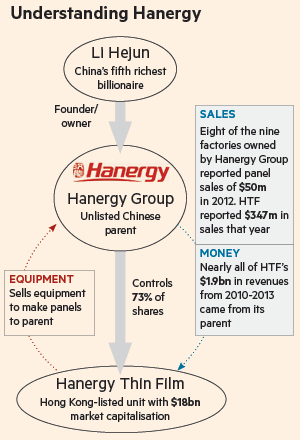
It is a Chinese company that promises to revolutionise the way solar power is used and to become the Apple of green energy. The breakneck growth of Hanergy Group, the world’s largest solar company by market value, has helped to make its founder China’s fifth richest man. Shares in its $18bn Hong Kong-listed subsidiary, Hanergy Thin Film Power Group, have risen more than 300 per cent since the start of 2014. Hanergy is building factories across China and has snapped up four overseas developers of thin-film technology — a still evolving application — since 2009. Founder Li Hejun has told investors that Hanergy Group is destined to become the industry leader although, as yet, only a 10th of the world’s solar production is of this thinner, lighter technology because costs are higher than for other panels.

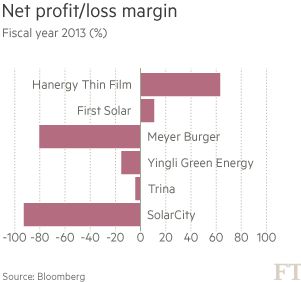
The Financial Times, in analysing recent financial statements of the company, has found some unconventional practices behind Hanergy Group’s soaring fortunes. It has been racking up enviable revenues largely through sales between its listed subsidiary, HTF, and itself. While many of its rivals have struggled to remain profitable, HTF, which sells equipment used to make solar panels, has reported net profit margins of over 50 per cent.

Hanergy Li HejunHanergy1Hanergy4Hanergy2Hanergy3

Continue reading