Ownership structure in the local Asian companies needs to be balanced for limiting the domination of family stakes in order to help check the alleged practices of manipulating their operational and financial activities through Real Earnings Management (REM)

http://www.thefinancialexpress-bd.com/2015/01/19/76604

Ownership structure in local cos needs to be balanced

FE Report

19 January 2015

The Financial Express (Bangladesh)

Bangladesh, Jan. 19 — Ownership structure in the local companies needs to be balanced for limiting the domination of family stakes in order to help check the alleged practices of manipulating their operational and financial activities through Real Earnings Management (REM), a researcher said.

Referring findings of a study report on such an issue in Japan, an expert came up with the observation at an international conference on “Accounting for Capital Governance” Sunday. Dr Mohammed Mehadi Masud Mazumder, assistant professor of the Department of Accounting and Information Systems (AIS), Dhaka University, presented the study on “Real Activity-based Earnings Management in Japan: Examining the Roles of Sophisticated Investors” at a session of the conference. Continue reading
Britain’s Serious Fraud Office (SFO) has closed its investigation into the ill-fated sale of Autonomy to Hewlett-Packard in 2011, saying there was not enough evidence to secure a conviction of the software firm’s former executives

http://www.reuters.com/article/2015/01/19/hp-autonomy-sfo-idUSL6N0UY26N20150119

UK’s Serious Fraud Office ends investigation into HP-Autonomy deal

10:03am EST

* UK’s SFO ends its investigation into deal to buy Autonomy

* SFO cedes jurisdiction of parts of case to U.S. authorities (Adds HP, former Autonomy CEO Lynch reaction)

By Paul Sandle

LONDON, Jan 19 (Reuters) – Britain’s Serious Fraud Office (SFO) has closed its investigation into the ill-fated sale of Autonomy to Hewlett-Packard Co in 2011, saying there was not enough evidence to secure a conviction of the software firm’s former executives. Autonomy was supposed to be the $11.1 billion centrepiece of a shift into software for HP, but the deal turned sour a year later when it wrote off three quarters of the company’s value.

HP alleged “some former members of Autonomy’s management team used accounting improprieties, misrepresentations and disclosure failures” to inflate the company’s apparent worth by more than $5 billion. Autonomy’s former management, including company founder Mike Lynch, has denied the allegations. Continue reading

[Flashback] Jim Cramer reveals dirty tricks short sellers use to manipulate stock prices down

Posted by CHEN TianCheng, Year 4 undergrad at the School of Accountancy, Singapore Management University

What I found relevant were the ways that short-sellers could manipulate the market and make quick money out of it (in many cases, this would be the minority investors). My purpose for sharing this is to bring up the point that unlike us thinking that the perpetrators of frauds are the only bad guys, short-sellers can also do ethically questionable actions given the amount of funds they have on hand.

External auditors in India

Posted by CHEN TianCheng, Year 4 undergrad at the School of Accountancy, Singapore Management University

Prior to reading this, I was not aware that in India, there was a different expectation towards external auditors compared to in Singapore, that the external auditors have the onus to detect fraud in their performance of the statutory audit. This is significantly different in Singapore, where our purpose is not to uncover fraud, but to ensure no material misstatements are uncorrected, that can change an intended user’s decision.

This difference is illustrated here in the amendments to the India Company’s Act in 2013.

http://www.thehindubusinessline.com/industry-and-economy/fraud-detection-is-now-responsibility-of-cas/article5455700.ece

I also found a PwC’s special report on MCX in India which unveiled 676 related parties other than the 235 that were already disclosed. This discrepancy was unveiled only after decades.

http://businesstoday.intoday.in/story/pwc-report-mcx-raises-questions-on-role-of-statutory-auditors/1/206318.html

Experts are still questioning the role of auditors in India, whether it is their responsibility to detect fraud, and they bring up valid problems that external auditors face in the performance of audit procedures. If they are required to uncover fraud, it would probably mean that they need to check every transaction and not do the usual sampling processes that is usually performed to ensure no material misstatements.

Hong Kong Regulator Alleges Misleading Research on Accounting Fraud of HK-Listed Chinese Companies; SFC Pursues Actions Against Moody’s, Citron

http://www.wsj.com/articles/hong-kong-regulator-alleges-misleading-research-1421616733

Hong Kong Regulator Alleges Misleading Research

SFC Pursues Actions Against Moody’s, Citron

ENDA CURRAN And RICK CAREW

Updated Jan. 18, 2015 4:34 p.m. ET

Hong Kong’s securities regulator is turning up the heat on what it considers to be misleading stock research. In recent months, the Securities and Futures Commission has pursued separate actions against U.S. ratings firm Moody’s Investors Service Inc. and a California-based short seller for releasing what it claims were misleading reports on Hong Kong-listed companies that sent their stock and bond prices tumbling.

The regulator’s actions against Moody’s and the head of Citron Research are rare instances of a developed-market regulator taking on a ratings firm or a research analyst for the content of their reports. In short selling, which is legal in Hong Kong and some other countries such as the U.S., an investor sells borrowed shares in hopes of buying them back later at a lower price, pocketing the difference. Continue reading

Woof-woof: Auditing companies to get an international watchdog – by 2017

http://asia.nikkei.com/Politics-Economy/Economy/Auditing-companies-to-get-an-international-watchdog

Woof-woof: Auditing companies to get an international watchdog

16 January 2015

Nikkei Report

TOKYO — Financial authorities of 51 nations and regions in the West, Asia and Middle East are planning to set up an organization to supervise auditing corporations by 2017. The authorities hope that reinforced supervision will ensure confidence in auditors. Distrust in auditing firms has been mounting since 2001, when U.S. energy giant Enron suddenly went belly up. A series of accounting fraud scandals has followed. Continue reading

[Flashback] Hong Kong banks caught up in ‘boiler room’ money laundering schemes

http://www.scmp.com/business/money/article/1681719/hong-kong-banks-caught-boiler-room-money-laundering-schemes

Posted by Sean CHUA Kian Shun, Year 4 undergrad at the School of Information Systems, Singapore Management University

Thailand and Philippines based “boiler rooms” laundered cash worth hundreds of millions of US dollars through Hong Kong’s banking system over the past decade, according to incriminating documents released online by aggrieved investors now angling for financial settlements with boiler room kingpins – and the banks that helped them. Continue reading

ASIC to crack down on miners’ dodgy overseas assets to prevent the next Sino-Forest; failure of auditors to meet generally accepted auditing standards with respect to collecting evidence regarding overseas operations

http://www.afr.com/p/national/asic_to_crack_down_on_miners_dodgy_hJB4HlCfGCv3KBrNfLWsfL

ASIC to crack down on miners’ dodgy overseas assets

PUBLISHED: 13 JAN 2015 00:04:00 | UPDATED: 13 JAN 2015 07:08:04

Over a third of companies listed on the Australian Securities Exchange, predominately mining and resource companies, have significant operations or assets located across Asia, South America and Africa. Photo: Reuters

The Australian Financial ReviewASX

BY PATRICK DURKIN

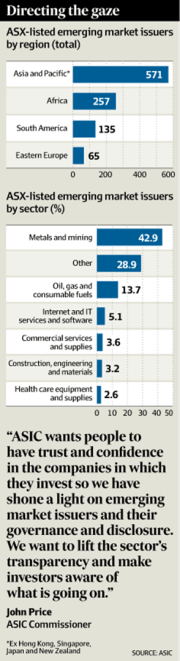
The corporate regulator plans a ­crackdown on mining companies ­promoting risky offshore assets, insider traders, financial planners and ­investors being duped by misleading advertising.

The Australian Securities and Investments Commission is concerned Australians could be sucked into ­investing in companies listed on the ASX but mainly operating overseas that do not meet Australian ­corporate-law ­standards.

ASIC plans to review a significant proportion of important corporate ­documents, including prospectuses which raise money from Australian investors, despite the companies’ ­operations being based predominately in emerging markets, including China.

Over a third of companies listed on the Australian Securities Exchange, predominately mining and resource companies, have significant operations or assets located across Asia, South America and Africa, leaving Australian investors exposed to foreign corporate corruption and poor legal protections.

The high-profile collapse of ­Chinese-based timber harvester Sino-Forest Corporation, which traded on the Toronto Stock Exchange and now faces allegations of fraudulently inflating its assets and earnings, heightened ASIC’s concerns local investors could be burnt by poor practices overseas. Continue reading

[Flashback] Accountants face Kanebo fraud charge

http://www.japantimes.co.jp/news/2005/09/12/national/accountants-face-kanebo-fraud-charge/#.VLn7htH9lsA

Posted by AMY Chan Wen Yi, Year 4 undergrad at the School of Accountancy, Singapore Management University

Prosecutors are set to charge several certified public accountants at a Japan unit of the PricewaterhouseCoopers group with collaborating with executives at Kanebo Ltd. in an accounting fraud that has humbled the once premier cosmetics and textile company, according to investigative sources. Continue reading

[Flashback] The dozy watchdogs

Posted by NG Sin Ying, Year 4 undergrad at the School of Accountancy, Singapore Management University

http://www.economist.com/news/briefing/21635978-some-13-years-after-enron-auditors-still-cant-stop-managers-cooking-books-time-some

Some 13 years after Enron, auditors still can’t stop managers cooking the books. Time for some serious reforms

NO ENDORSEMENT carries more weight than an investment by Warren Buffett. He became the world’s second-richest man by buying safe, reliable businesses and holding them for ever. So when his company increased its stake in Tesco to 5% in 2012, it sent a strong message that the giant British grocer would rebound from its disastrous attempt to compete in America. Continue reading