Bonus hogwash: The Stock Exchange and SFC continue to allow companies to make false and misleading statements about “bonus” issues of shares

http://webb-site.com/articles/bonusBS.asp

Bonus hogwash
11th June 2015

An awful lot of hogwash (we are using a family-friendly word) is produced in this town when companies announce “bonus issues” of shares, and the Stock Exchange and SFC continue to allow them to get away with making false and misleading statements in their “reasons for the bonus issue”. Indeed the very name is misleading – there is no “bonus” in issuing shares for free, because the increase in the number of shares is offset by a decrease in value per share.

Today’s glowing example comes from Forefront Group Ltd (Forefront, 0885). After a magical rise in its share price of 359% so far this year, it proposes, in its circular dated 12-Jun-2015, a bonus issue of 9 new shares for every share held. Economically this is the same thing as splitting each share into 10 shares. It makes no difference to the net assets of the company or the value of shares held by each shareholder, other than subtracting the costs spent on the exercise including producing the announcement and circular, sending out new share certificates and holding a general meeting.

Let’s analyse the false and misleading statements in the “reasons” section on page 9: Continue reading

China Firms Fleeing U.S. Listings Leave Bondholders in Dark; “The implication of the privatization wave for bondholders is once the company is delisted, there is likely to be less financial disclosure.. This means that if the company does any profit warning, they are not required to file in the stock exchange anymore.”

http://www.bloomberg.com/news/articles/2015-07-03/china-firms-fleeing-u-s-listings-leave-bondholders-in-the-dark

China Firms Fleeing U.S. Listings Leave Bondholders in Dark

by Lianting Tu

July 3, 2015 — 10:52 AM SGTUpdated on July 3, 2015 — 5:26 PM SGT

The record pace of Chinese companies leaving U.S. exchanges is spurring concern among bondholders that transparency and corporate governance may worsen. Continue reading

Modus operandi of the SME IPO scam

Modus operandi of the SME IPO scam
N SUNDARESHA SUBRAMANIAN New Delhi
1 July 2015

The Securities and Exchange Board of India (Sebi) has unearthed a huge network of entities, which systematically rigged the initial public offerings (IPO) on the small and medium enterprises (SME) exchange platform. Their operations were so well-planned and coordinated that these carried on for more than a year beginning with preferential allotment several months before the IPO, continuing long after the listing.

Sebi’s investigation has revealed that the scamsters floated these firms, allotted fresh shares to themselves, distributed these to some front entities, sold these on IPO, funded the people who bought these on IPO , appropriated the IPO proceeds, and then funded the group of traders who were then hiking up the prices endlessly. All to convert unaccounted money into legitimate money that can be attributed a source: the stock exchange. Continue reading

With over a decade having passed since auditors’ role came into question in the Ketan Parekh stock market scam, auditing regulator ICAI has blamed “litigations and frequent adjournments” for delay in its action against the concerned member auditors.

http://www.business-standard.com/article/pti-stories/ketan-parekh-scam-icai-blames-litigations-for-delay-in-action-115063001033_1.html

http://www.business-standard.com/article/current-affairs/ten-years-on-icai-probe-into-gtb-auditors-role-still-not-complete-115062900065_1.html

Ketan Parekh scam: ICAI blames litigations for delay in action

30 June 2015

Press Trust of India

New Delhi, Jun 30 (PTI) With over a decade having passed since auditors’ role came into question in the Ketan Parekh stock market scam, auditing regulator ICAI has blamed “litigations and frequent adjournments” for delay in its action against the concerned member auditors. Continue reading

[From the Archives] Exit Barriers for U.S.-Listed Chinese Stocks: Chinese companies, some of which stung by accounting scandals on U.S. stock markets, are now struggling to privatize, delist and move on

http://english.caixin.com/2012-01-21/100350742.html

01.21.2012 15:30

Exit Barriers for U.S.-Listed Chinese Stocks: Chinese companies, some of which stung by accounting scandals on U.S. stock markets, are now struggling to privatize, delist and move on

By staff reporters Huo Kan in New York and Zhang Tao in WashingtonJinan-based software developer Pansoft Co. Ltd. says it’s going private, climbing aboard an increasingly crowded life raft as Chinese companies abandon U.S. stock investors. As of mid-January, some 20 of the 230 Chinese companies with stock traded on the New York or Nasdaq exchanges had announced privatization plans. At least eight in the group had completed the process. The privatization push, expected to accelerate in 2012, stands in stark contrast to the scene in early 2011 when Chinese companies were frantically competing to list on U.S. stock markets. That was before accounting scandals and short-sellers hammered a few high-profile companies, damaging the image of Chinese concept stocks overall. Continue reading

[From the Archives] Reasons, Impacts, and Implications of the Delisting Wave of Mainland Chinese Enterprises Listed in U.S. Stock Markets; An increasing number of Chinese companies were delisted or privatized due to class action fraud litigations and short-selling pressure from institutional investors

http://economists-pick-research.hktdc.com/business-news/article/Economic-Forum/Reasons-Impacts-and-Implications-of-the-Delisting-Wave-of-Mainland-Chinese-Enterprises-Listed-in-U-S-Stock-Markets/ef/en/1/1X000000/1X07SY24.htm

30 Nov 2011

Reasons, Impacts, and Implications of the Delisting Wave of Mainland Chinese Enterprises Listed in U.S. Stock Markets

Since 2011, a series of Mainland Chinese enterprises listed in U.S. exchanges have been suspended, delisted, privatized, or reverted to over-the-counter transactions. This phenomenon attracted wide-spread media attention, and the companies involved include Xinhua Sports and Entertainment, Shanda Interactive Entertainment, FunTalk, Jiangbo Medicine Group, China Security Surveillance Technology, and Shandong Yuhe Group. This paper analyzes the reasons and impacts of the delisting wave as well as its implications on Hong Kong’s IPO capacities and the consolidation of the city’s status as an international financial center.

The variety of factors that triggered the delisting wave
Since mainland enterprises started going public in overseas markets in early 1990’s, the U.S. has been a main destination. There have been four episodes of IPO booms in America (see Table 1), with Internet companies such as Renren, NetQin, Jiayuan.com, and Qihu 360 Technology going public in the first half of 2011. The turning point was the second half of last year, when an increasing number of Chinese companies were delisted or privatized due to fraud litigations and short-selling pressure from institutional investors. Continue reading

Enron’s former CFO cautioned that modern accounting methods could be legal while still presenting a misleading picture of a company’s health; “There may be a fundamental difference between a company following the rules and a company presenting a true picture of its financial position”; “I was not the chief financial officer. I was the chief loophole officer”

http://www.ft.com/intl/cms/s/0/8ffd2c8a-201e-11e5-ab0f-6bb9974f25d0.html?nl=business&emc=edit_dlbkam_20150702#axzz3ejJOa92X

July 1, 2015 8:11 pm

A prison ID in one hand — and a CFO award in the other

David Sheppard and Neil Hume

Enron

Andrew Fastow, former Enron CFO, complete with prison ID card

Former Enron chief financial officer Andrew Fastow says that following accounting rules to the letter contributed to the infamous collapse of the US energy trader and landed him in jail.

In a candid and wide-ranging presentation at the FT Camp Alphaville summit, dubbed “The Smart Guy in the Room”, he cautioned that modern accounting methods could be legal while still presenting a misleading picture of a company’s health.

“There may be a fundamental difference between a company following the rules and a company presenting a true picture of its financial position,” he told an audience assembled for the annual get-together for the FT’s financial and markets bloggers and its readers. Continue reading

China graft probe uncovers falsified revenues at large SOEs, including well-known names such as State Grid, China Ocean Shipping Co (Cosco) and China Southern Power Grid

http://www.bloomberg.com/news/articles/2015-06-28/china-s-auditor-says-state-firms-falsified-revenue-and-profit

http://www.ft.com/intl/cms/s/0/91b7855c-1d85-11e5-ab0f-6bb9974f25d0.html#axzz3eWUEQx9H

June 29, 2015 7:17 am

China graft probe uncovers falsified revenues at large SOEs

Patti Waldmeir and Gabriel Wildau in Shanghai

China’s state auditor has uncovered falsified revenues and profits in the accounts of some of the country’s biggest state-owned companies, as Beijing broadens its assault on official corruption.

The National Audit Office said on Sunday that 14 state-owned groups, including well-known names such as State Grid, China Ocean Shipping Co (Cosco) and China Southern Power Grid, falsified nearly Rmb30bn ($4.8bn) in revenue and nearly Rmb20bn in profits in 2013. Continue reading

About $12bn of equity capital is trapped in HK-listed companies that have not traded in at least three months — a number that will more than double if Hanergy Thin Film, now frozen for six weeks following its spectacular fall from grace, does not resume trading soon

http://www.ft.com/intl/cms/s/0/5ca19360-1f0d-11e5-aa5a-398b2169cf79.html#axzz3ejJOa92X

July 2, 2015 4:52 am

Hong Kong share suspensions irk investors

Jennifer Hughes in Hong Kong

SuspensionSuspension2

When Silchester first bought into the South China Morning Post, the fund manager was investing in a group once touted as the most profitable newspaper in the world. Seventeen years later, the media landscape has changed dramatically but Silchester’s investment has not — partly because SCMP Group shares have been frozen for two-plus years by Hong Kong rules that allow stocks to languish for years without being traded. The issue is a perennial source of frustration for investors, particularly given the city’s status as Asia’s leading stock market and the gateway to China. “We find the whole saga astounding — we would not expect such an affair in any developed stock market,” says Stephen Butt, chairman and chief executive of Silchester International Investors, which holds 14 per cent of SCMP Group. He adds: “Our clients, who include many leading international foundations, endowments and charities, are suffering. Why should their interests be abused in this way and to whose benefit?”

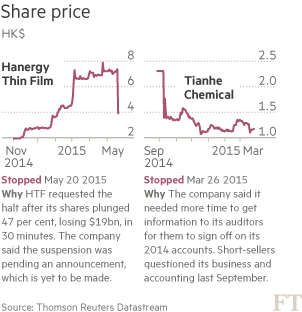
About $12bn of equity capital is trapped in companies that have not traded in at least three months — a number that will more than double if Hanergy Thin Film, now frozen for six weeks following its spectacular fall from grace, does not resume trading soon. Continue reading

Ex-securities broker jailed after counseling Olympus on hiding losses

http://www.japantimes.co.jp/news/2015/07/01/national/crime-legal/ex-securities-broker-jailed-counseling-olympus-hiding-losses/#.VZOeovmqpBd

Ex-securities broker jailed after counseling Olympus on hiding losses

KYODO

JUL 1, 2015

The Tokyo District Court on Wednesday sentenced a 61-year-old former securities broker to four years in prison for counseling the management of major optical equipment-maker Olympus Corp. on hiding massive losses.  Continue reading